
by Joseph Stoutzenberger
I spent my early adult years in what some at the time believed to be the “dawning of the age of Aquarius,” when peace would guide the planet, as the musical “Hair” proclaimed. Many young people in America and across the world believed that humanity was finally realizing the futility of war and would embrace non-violence as the only true path to peace and happiness. Left unchecked, wars would hasten humanity’s demise on the earth. The backdrop for Americans of my age was the Vietnam War. We saw guys we played basketball with whisked off to jungles far away, at times returning with physical injuries that kept them from ever playing the sport they loved ever again. Others came back with injuries that were not visible but that were no less debilitating. If they opened up at all, they often said they were haunted by the question, “Why did I survive and some of my buddies didn’t?” Inspired by Mahatma Gandhi, who mounted a nonviolent campaign to achieve Indian independence from Britain, and Martin Luther King, Jr., who used non-violence in creative ways to make strides toward ending racial discrimination in the U.S., we held out hope that alternatives to war existed. Gandhi called his approach satyagraha, “truth force” or “soul force.” Success in war was determined by military might, not by who had truth on their side. Gandhian non-violence was not weakness or passivity. It was based not on “might makes right” but on “right makes might.”
So much for the dawning of the age of Aquarius. In 2025 voices calling for embracing non-violence are being drowned out by bombs dropped from the sky over Ukraine and Gaza. Many other trouble spots are rife with people seeking success through violence without any thought that nonviolent methods might be more effective long term. Conflict is even smoldering in the tensions that exist within our own political and cultural landscape. Is Gandhi’s soul force still powerful enough to help people navigate their way through conflicts?
Step back for a moment and reflect on where Jesus stood on the question of violence versus non-violence. Each gospel tells about Jesus’s angry display in the temple area, when he took off his sash and waved it around to show his displeasure at the buying and selling he considered desecrating this sacred area. Was it an act of violence or nonviolent protest? We still debate where the line is drawn between the two. Protesting in front of a courthouse is one thing; chaining oneself to courthouse doors is another? Nonetheless, a number of prominent scripture scholars see Jesus’s message as one of non-violence–Walter Wink and John Dominic Crossan, for example. Jesus did not align himself with those in his Jewish community who espoused the use of violence to drive out the Romans. Generally speaking, early Christians understood Jesus’s message to be one of non-violence. That position eroded over time with Emperor Constantine and St. Augustine proposing that there is a place for justified violence.
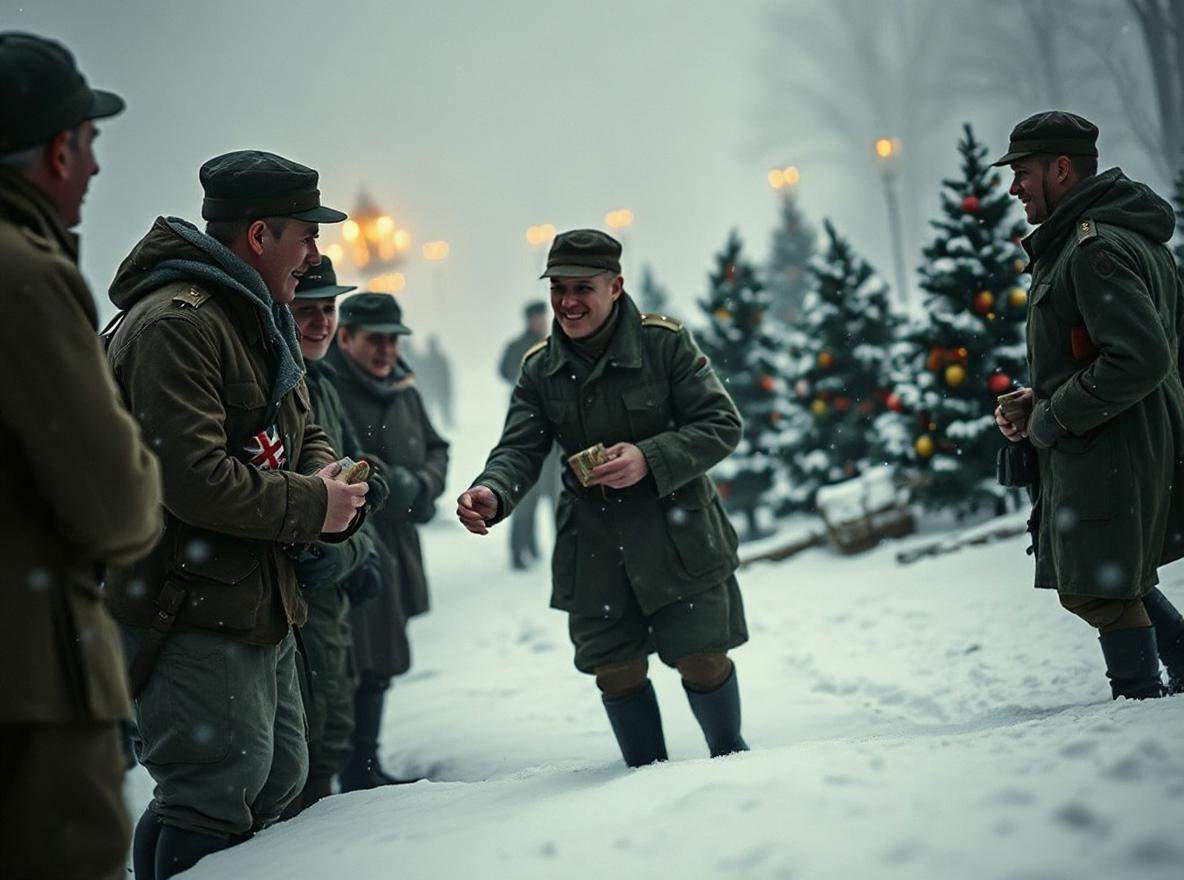
Gandhi developed a number of principles and tactics for use in resolving conflicts nonviolently. One underlying principle is seeking to identify truths that both sides can agree on. No victory is lasting unless both sides agree on the results. That principle is difficult to put into practice when people on the other side of a conflict are demonized. An intriguing example of the light of non-violence shining in the darkness of violent conflict took place on Christmas Eve, 1914, during World War I. Trench warfare meant that soldiers on both sides were hunkered down in trenches within earshot of each other. This Christmas Eve some German soldiers lit candles on some evergreen trees and began singing carols that could be heard by the Scottish, British, and French troops on the other side of “no man’s land.” Allied soldiers began to sing carols as well. At one point, a German soldier ventured out of his trench and was not shot. Instead, soldiers on both sides came out and greeted one another, exchanging photos of loved ones and offering Christmas wishes. Some joined in a friendly soccer game. A famous German juggler, now in uniform, performed for the gathering. There was even time for a few haircuts. When generals on both sides got wind of what was happening, they commanded that there should never be fraternizing with the enemy for the remainder of the war. It’s hard to kill someone who just showed you pictures of his wife and children and with whom you just sang carols.
More recent examples of breaking down barriers can be cited. Israeli settlers on the West Bank live next to Palestinians, and yet they live completely separate lives. Some residents decided to create a space where members of both groups could meet and talk about their fears and hopes. An organization in Israel started a youth circus club and invited Jewish and non-Jewish teenagers to join. Mutual trust is needed when performing acrobatic acts. Young people might even become friends. During the height of Protestant-Catholic conflict in Northern Ireland, an organization sponsored sending children from both groups to summer camp in the U.S. For Gandhi, a first step toward resolving conflict is recognizing and experiencing the humanity of others. Conversations need to focus on common concerns, fears, and hopes before differences can be addressed. Killing must stop; talking must start. Not as enemies but as people seeking truth all can agree on. Not an easy task, but perhaps the dawning of the age of Aquarius after all.
 Joseph Stoutzenberger