Some years ago, I was visiting a priest friend of mine who was pastor of a large, active parish. A man in his sixties, he was the only priest serving the parish. I asked him why he didn’t request a newly-ordained priest to be assigned to help him. He said quickly, “Most of them worship a God different from the one I do.” That response caught me by surprise. He went on to say that he and a few other older priests conducted an intervention with one new priest who was refusing absolution to penitents in confession if he felt they were not sincere. The older priests pointed out to him that his job was not to judge but to represent the merciful, loving Christ who told his followers to forgive others “seventy times seven times.” That exchange led me to question if, indeed, there are conflicting notions of “God” within Christianity itself. Are some Christians worshiping idols, even though the name of that idol is “Jesus?”
A number of recent studies are pointing out that there is politics behind the word “Christian.” In Christian: The Politics of a Word in America, Matthew Bowman examines the trend among some conservative Christians to identify the religion with the United States itself. The thinking is that America was founded by inheritors of the Protestant Reformation so that Christianity, the United States, and Western Civilization itself are essentially synonymous. The Christian identity of America is under attack today from sources within the nation itself, secular humanists, and immigrants from non-Protestant, non-white, non-European countries. From this perspective, certainly, Muslims are a threat, as are immigrants from Africa and Latin America. Pope Francis spoke about this exclusionary understanding of Christianity in his book “Let Us Dream,” written with journalist Austen Ivereigh. Pope Francis declares this mentality to be a distortion of Christianity that is intended to serve only the interests of those who propose it. He is echoing what Jesus said, that “not everyone that says to me, ‘Lord, Lord,’ will enter the kingdom of heaven.” In the line before that, Jesus says, “You will know them by their fruits” (Matthew 7: 20-21).
My priest friend and Pope Francis are talking about idolatry, perhaps made worse because it is done in the name of Christianity. How might those of us who have a different understanding of God and what Christianity stands for counter these more narrow views? Pope Francis offers some suggestions. For one, he advocates dialogue. Like many people who have had occasions to dialogue with different groups, I have found it easier to engage with people from other religions than with members of my own who hold a different worldview, but it’s possible and helpful to find common ground with one’s family. In addition, Pope Francis’s “Let Us Dream” is a call to action. Live the Christian life in such a way that people will associate “Christian” with hospitality, kindness, and shared joy. Rather than fear and hatred of the other, put the dream into action so that the first association people make with Christianity is an expansive view of what was said of them in the early days of the religion: “See how these Christians love one another.”
A Christmas Eve morning news program ended with a panel discussing “the true meaning of Christmas.” At the heart of the discussion was, of course, “Keep Christ in Christmas.” One commentator railed against the materialism underlying all the shopping and gift-giving. Another suggested that doing random acts of kindness would be a way to demonstrate the spirit of Christmas. A third pointed out that after Jesus was born, the family returned to Nazareth and lived a normal, everyday life among family and fellow townspeople. These sentiments are worthy and hard to disagree with. To critique them is like critiquing Mother Teresa. It’s mind-boggling that we even need to admonish people to be kind and neighborly to one another, and for many years now, the materialism associated with Christmas has been addressed in churches and even in popular holiday movies. Even the word “normal” is poignant today. So many of us long for what we perceive as living a normal life while the scourge of COVID-19 rages on and political turmoil makes for an unsettling atmosphere in the country. However, as much as these messages are needed, they can be as nourishing as white bread. Do these messages truly reflect the Christmas spirit?
When thinking about Christmas gift-giving, a story from my own life comes to mind. In my teen years, I worked in a steel plant that made pipe fixtures. Conditions were oppressive. Dust filled the air; the noise level was deafening. The temperature near the cupolas spewing out molten steel was beyond tropical. The half-hour lunch break began precisely on time, and when it was over everyone needed to be on the assembly line ready to work. After every eight-hour shift, fifty men at a time crowded into open showers to wash off the dirt and grime. It was a great impetus for me to go to college. The top workers were the molders who shaped the casts for the pipe fixtures as a conveyor belt carried them past the men who poured the red-hot steel into them. Weekly pay was determined by production levels. The more pipes made, the greater the pay for everybody. Fewer pipes meant smaller paychecks. Invariably, output increased in late fall and early winter. I asked a more experienced co-worker why the molders were pushing themselves so much harder at this time of year. He told me that the men wanted larger paychecks so that they could afford to buy Christmas presents for their families.
Were these men succumbing to the allure of “materialism”? I understood what they were doing as an act of love. They lived paycheck to paycheck. If their children were to find presents under the tree, then they would have to work harder. They were already endangering their lives by working in such inhumane conditions. (My time there was cut short when I developed bronchitis from breathing in the sooty air.) The molders picked up the pace so that a little more money would be available for their children. For many poor families, Christmas is the only time they can scrape together enough money to buy gifts. A bike or a new sweater may not explicitly relate to the birth of Jesus but looked at in proper light, it is not foreign to the “keep Christ in Christmas” message. After all, Jesus himself received presents on Christmas!
Moving Beyond Individual Acts of Kindness
When it comes to acts of kindness, the airways are filled with inspiring stories of people helping others in need leading up to Christmas. Plenty of opportunities present themselves to us for donating food, blankets, and toys. It’s hard to argue that Jesus would not advocate acts of giving as a way to celebrate his birth. However, there is a dimension to his message that can be overlooked in emphasizing acts of kindness by individuals or organizations. Isn’t it true that, before John Lewis, Jesus called upon his followers to “make good trouble”? Maybe Joseph led a life of working hard, being kind, being generous when he could, keeping out of trouble, and not upsetting anyone. However, that’s not the life Jesus chose to live. At some point, he decided that he could no longer continue working as a carpenter and keeping his mouth shut. He began preaching a message that drew many people to him, but that also got him in trouble with some very powerful people. His family wanted him to return to his life of making a meager living and not challenging the structures of his society. Jesus didn’t back down. He continued to make good trouble, even though he had to know that it would lead to his arrest and probable death.
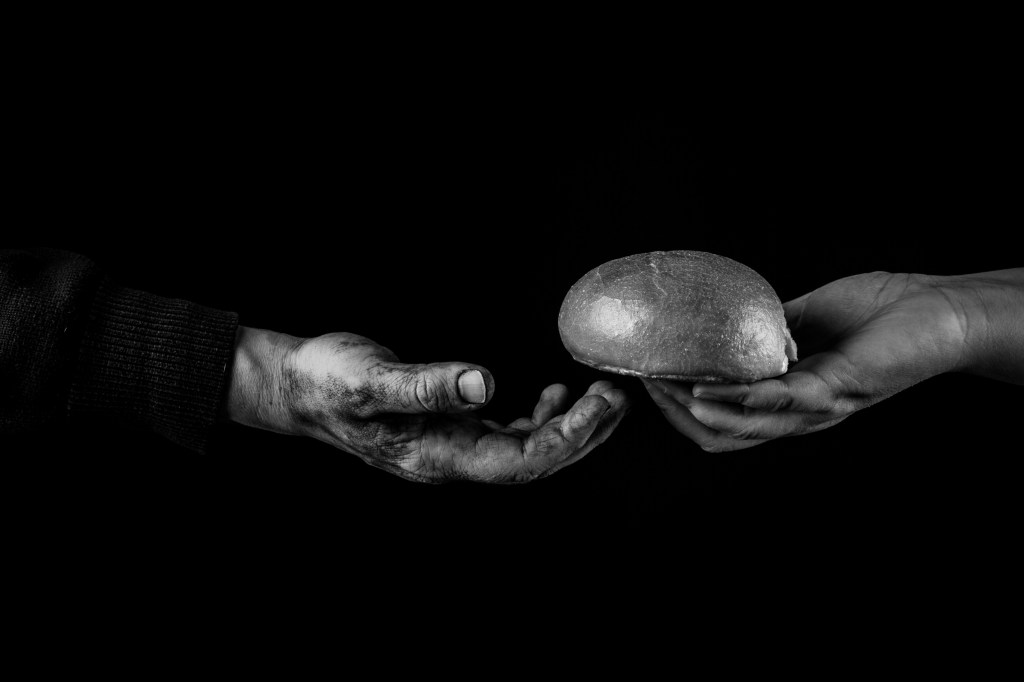
A woman is giving bread to a poor man in need. Helping Hand Concept. Black and white
The Christmas story, rightly understood, is as challenging as it is comforting. Jesus is born away from home without proper shelter to warm and protect him. Isn’t there a message in that scene beyond serving up food at a homeless shelter on Christmas day? It seems to imply that we should advocate for policies that treat foreigners humanely and help people get off living on the streets. Shepherds are an important fixture in any manger scene or grade school Christmas pageant. Shepherds were definitely not the “haves” of ancient Israeli society. They were people whom members of proper society went to great pains to avoid. We may nod to the importance of farmworkers and factory workers, but making sure that workers on the lower end of the wage scale are guaranteed a living wage calls for political involvement. In some localities, advocating for a decent minimum wage can get a politician voted out of office by the very people who celebrate the birth of the poor one whose message first came to people subsisting on the lowest rung of the socio-economic spectrum. It’s easy to overlook the political implications of another essential element of the Christmas story. Jesus is kept alive by the warm breath of the animals in the stable. How are other creatures doing in our anthropocentric world? What changes are called for to protect members of other species along with the elements of the environment that sustain life? The Christmas stories in the gospels, rightly understood, both comfort and confront us.
Sorting through the Clutter
Undoubtedly, the ambiance surrounding Christmas has become as superficial as the dreams of the sleeping couple in “The Night Before Christmas.” As far back as 1949, E. B. White wrote elegantly about the dangers of creeping materialism associated with Christmas: “To perceive Christmas through its wrappings becomes more difficult with every year.” He reminded his readers that it is more and more of a challenge “to hear the incredibly distant sound of Christmas in these times, through the material woods that surround it.” And he was writing before “elf on the shelf” and the endless lineup of syrupy Christmas movies on the Hallmark Channel. However, gift-giving can reflect the spirit of Christmas. Pope Francis, for one, reminds us to be cautious about the trap of materialism; but that doesn’t mean that material things are bad in themselves. Parents face a persistent challenge to help their children keep possessions in proper perspective and to appreciate the simple message of Christmas.
Catholic “Both-And” Mentality Applied to Christmas
Not all elements of popular culture need to be jettisoned as if the choices are “either-or.” We either went to church or we went to the mall. Either we sing carols or “Frosty the Snowman.” Catholic sentiment has always leaned toward the “both-and,” although, as E. B. White pointed out, it is increasingly difficult to sort through the clutter. Most Christian families approach the holidays seeking to maintain a balance—presents under the tree along with a manger scene prominently displayed. It’s a challenge to be vigilant in determining what popular add-ons to Christmas are a blessing or at least a pleasant divergence. Surely the “Peanuts” Christmas special and Dickens’s Christmas Carol deserve to be placed in the “blessing” category, but many other films fall into the “pleasantly divergent” category at best. Plenty of family traditions reflect the spirit of Christmas, often simply because they are family traditions—baking cookies to share with friends and neighbors or watching together a favorite Christmas movie.
Cat and Dog eating and drinking Santa’s cookies and milk.
Holding onto the Message of Christmas
Like so many good stories, the Christmas story is simple but profound, presenting a straightforward message with endless implications. The love of God that we long for in dark times takes flesh in the fragile, poor, needy baby of Bethlehem. We fall on our knees at the very thought of it. In response, we make the message real and tangible however we can. Years ago, St. Pope John XXIII said: “We are one great human family, proven each year by how we feel at Christmas.” Some expressions of popular culture exploit the season in ways that are detrimental to fostering an awareness of God’s love for the one great human family, but others are sincere attempts to bring the message to life. Heartwarming stories of kindness given and received do reflect the Christmas message. There are people who need immediate help, and supporting organizations that provide help for those in need bring out the meaning of the Christ child who was a gift to all the world. Building on that message to address discrepancies in power, privilege, and participation also lies at the heart of the true meaning of Christmas. Perhaps making the leap to that realization is even more challenging than sorting through the candy-coated enticements of pervasive materialism.
Heartwarming stories of kindness given and received do reflect the Christmas message. There are people who need immediate help, and supporting organizations that provide help for those in need bring out the meaning of the Christ child who was a gift to all the world.
I was sitting in a newly redecorated university chapel next to an artist friend of mine. I asked him what he thought of the ornate crucifix behind the altar. He responded, “It pretends to be art.” Despite the many failed attempts at artistic expression intended to open one’s gaze to the holy in Catholic culture, clearly, Catholicism has had a long love affair with art and has been one of the greatest proponents of art for two thousand years.
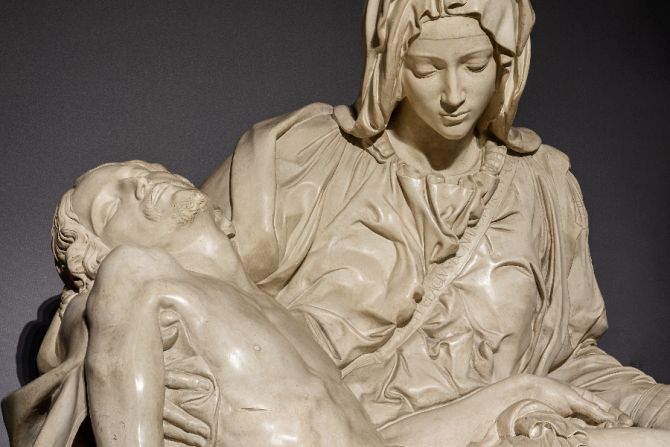
The Madonna della Pietà (1498–1499), informally known as La Pietà, by Michelangelo Buonarroti.
If you are not familiar with the books or videos of Sister Wendy Beckett, treat yourself to one. In the 1990s, she hosted two series on art for the BBC and wrote a number of books as well. She does not confine herself to what we might think of as “religious” art. However, she sees experiencing art as not just a pleasure but as a doorway to spiritual awareness. Consider The Gaze of Love to get a sense of how she finds a wide variety of art, offering insights into the human condition that can serve as catalysts for prayer.
Last month, Pope Francis spoke to a gathering of artists to commemorate the fiftieth anniversary of the Vatican Museum’s modern art section. He quoted the noted twentieth-century theologian Romano Guardini as saying that “the situation of the artist is not unlike that of a child and even that of a visionary.” That is, good artists look at reality around them with a sense of wonder, finding beauty that others can miss like a child does. It is akin to what Zen Buddhists call having a “beginner’s mind.” This freshness of perspective is also that of a visionary who sees possibilities for what can be. It is like the message of the Hasidic tale in which a student asks a rabbi, “When can we tell the moment of dawn? Is it when, from a distance, we can distinguish between a dog and a sheep?” The rabbi answers, “No, it is dawn when we can look at another and recognize that person as our sister or brother. Before that, it is still darkness.” A work of art opens us up and leads us to enter “a space into which we can step,” where we encounter objects, events, and persons in a new light.
I have friends who are artists and poets. One friend of mine, Frank, spends his early hours painting every day, at times adding a poetic reflection to accompany the painting. A poet friend of mine, Ed, has a way of describing commonplace experiences that always leave me thinking, “Why didn’t I see that?” Sometimes we hear a song that speaks to our heart just at the moment we need to hear it, as if God is our dee-jay. I am not at home with art, visual art, poetry, or music. I have tried my hand at writing what I call poems when a scene or situation sparks a sense of appreciation when poetry seems to be called for. I am enclosing a poem I wrote, not because it is great poetry or even poetry at all, but as an encouragement to any who might read it to try their hand at being a child or a visionary, giving expression in some fashion to the beauty that surrounds us always.
Food Court

Food court at the mall is a sacred place.
A teenage girl with sparkling eyes,
Dark hair in rivulets down her forehead,
Chatters away over salad,
Her gawky boyfriend munching on Chick-fil-A,
Never uttering a word.

Young girls cluster together,
Heads turned inward, eyes outward,
Whispering, sharing secrets,
In search of…
Those boys from school!

A couple walks by arm in arm,
Dropped off in a van from a group home.
But there they are,
Together, haven for each other,
Making their way slowly through the crowd.

Young men flank each side of the court
Distributing communion—slivers of cheese steak
Or Chinese chicken on a toothpick—“special of the day.”

A Guatemalan man, like an altar boy,
Meanders among the tables,
Broom and dustpan in hand,
Picking up each morsel left behind.
This is his turf,
And he will keep it clean.

Thomas Merton was right.
We miss God
Not because there is too little of God
But because there is so much.
I spent sixteen years going to Catholic-affiliated schools, so when I graduated from college, I decided to learn about other religions on my own. I recall sitting on the beach at the Jersey shore reading the Qur’an when everyone around me seemed to be reading fluff mystery novels. I moved on to reading What the Buddha Taught and then some of the Bhagavad Gita and Heschel and Buber on Judaism. I attempted to read the bible all the way through but got bogged down in the law codes of Leviticus and Numbers.
As it turns out, I taught a world religions course for much of my academic career. I don’t believe I ever had a student decide to change religions because of studying about them. Something else happened instead. Notre Dame theologian John S. Dunne describes a process he calls “crossing over and coming back.” He recommends immersing oneself in another religion, seeking to understand and appreciate it as someone who is a member of that religion would. After an experience of immersion, return to one’s own religion, and you will find that you look upon your own in a new light. It’s somewhat like saying that one of the best ways to appreciate what it means to be an American is to travel to another country and seek to understand and appreciate its customs and culture. In that way, you can understand and appreciate American culture better and differently. (We don’t take siestas in the afternoon. Why not? What does that say about us?)
One book that can help people engage in this process of crossing over and coming back is Living Buddha, Living Christ, by the Vietnamese Buddhist monk Thich Nhat Hahn. He had many occasions to spend time with Christians and learn from them about their religion. He often found parallels between Buddhism and Christianity. When he heard about the Holy Spirit as the divine presence within people, he realized that it sounded very much like what Buddhists call mindfulness. The historical Jesus who comes to be viewed as Christ is similar to Siddhartha, who comes to be recognized as the Buddha, the awakened one.
Look up reviews of the book, and you will discover that many Christians feel as though his correlations between Buddhist concepts and Christian ones are belittling Christianity. Jesus is one with God, not simply “awake.” The vast majority of my Christian students who read the book find that Buddhist perspectives on reality help them better appreciate the meaning of their own beliefs.
A few years ago, I had an unplanned experience of crossing over and coming back at a Muslim festival in Philadelphia. I stopped at a booth that had pamphlets on interesting topics: Islam and Women, Islam and War. I picked up a few and stuck them in my back pocket. As I started to walk away, a woman behind the table beckoned to me: “Excuse me, sir, but you put those pamphlets in your back pocket. You might forget they are there and inadvertently sit on them. They contain the holy name of God.” I said, “Thank you very much. I would not want to sit on the name of God.” I was struck by the reverence shown to even the written name of God. We Christians tend to be nonchalant about and even disrespectful at times of writing or speaking God’s name. I had crossed over to a different appreciation for reverence toward the holy in scripture and discourse. It was a lesson I could apply to my own Christian attitude.
Eboo Patel had a different trajectory when it came to learning from and appreciating another religion and his own. He was raised in a Muslim family in Chicago but rebelled against it and stopped practicing. As a young man, he volunteered at a Catholic Worker House on the southside of Chicago and was impressed with the good work these Catholics were doing. A Franciscan brother there told him he should look into his own religion for wisdom and guidance. Patel discovered that care for those who are poor is a central teaching of Islam; it is one of its five pillars, zakat. He found in the Qur’an far more references to caring for people in need than about issues such as women’s dress that people associated with Islam. Patel was guided by the Franciscan brother to pass over from Catholicism to his own tradition and came back to it. Patel has established a leading organization to promote interreligious dialogue and young people from various backgrounds to work together for good.
America is increasingly a melting pot of many cultures and religions. Even my small hometown now has a Buddhist temple thanks to Cambodian refugees and a Confucian study center. If we apply John Dunne’s approach to these different traditions, we might come to a greater appreciation of our own. Try it.
I grew up in a small town where Catholics were scarce. One day, another Catholic boy and I were with some other boys. During the chatter among us, my Catholic friend began to curse and use foul language when describing someone he didn’t like. One of the non-Catholic boys said, “What a way to talk! And you’re Catholic!” Apparently, in his mind, Catholics were held to a higher standard of morality than other people.
The question about whether Catholicism is worth saving, addressed in my recent book and in an earlier blog, lingers on. All Catholics should ask themselves that question, and it is a question for members of all religions to ask themselves. Does being Catholic make a difference in how people live their lives? Are they, in fact, held to a higher standard of behavior than others? Should they be? Karl Marx rejected Christianity because he felt it contributed to oppressed people passively putting up with their fate because its message was that their true home and happiness existed only after death. Christianity offered no incentive to be compassionate and involved in trying to make this world a better place. However, history and current examples prove that Marx’s hypothesis is wrong. Catholics often engage in practices to make this world a better place for everyone, especially for people most in need.
Admittedly, the record is mixed. As a Catholic myself, I am always pleased to hear that Catholics are on the front lines in trying to help migrants on our southern border who have endured great hardships seeking a better life. Then I read about Catholic governors who seem to lack compassion, setting up roadblocks for those fleeing inhuman circumstances in their home country and are desperate for a helping hand to get them through their ordeal. Catholics have been at the forefront of protesting against the proliferation of nuclear weapons and what used to be called the School of the Americas, where Latin American soldiers, often in the service of dictators, learned how to quash rebellions with violent means. An impressive array of Catholics also makes up a disproportionate amount of military personnel, including the current Secretary of Defense. Catholics run food pantries and shelters for homeless people, but so do members of other religions. People who identify as Catholic attend weekly services at a lower rate than non-Catholics do now, a stark reversal from what was happening sixty years ago. Catholics are well-represented among far-right political circles but also in progressive movements. In America, Catholics get divorced, practice birth control, and have abortions at about the same rate as non-Catholics do. So, what difference does being Catholic make?
One place to look for an answer is in an exchange between Jesus and “the Twelve,” who are his closest followers. After hearing particularly baffling and challenging words from Jesus, many of the people who had been following him left him and renounced his message. Jesus asks the twelve, “Do you also wish to leave me?” Peter speaks for the group, saying: “Lord, to whom can we go? You have the words of eternal life. We have come to believe and to know that you are the Holy One of God” (John 6:68). Jesus does not offer a message that is easy, either easy to understand or easy to practice. Being Catholic means nothing if divorced from faith in Jesus. Being Catholic means seeking to know the will of God and to follow it as revealed in the life and teaching of Jesus. Given the enigmatic nature of Jesus’s message, that quest is ongoing and requires constant reexamination.
That non-Catholic boy was right to say, “You’re not supposed to talk that way. You’re Catholic!” Being Catholic is supposed to make a difference, and for so many Catholics, it does. It is not a one-size-fits-all response to Jesus but a lifelong commitment to seeking truth and living accordingly in one’s particular circumstances. If you find Jesus as compelling as Peter and the Twelve did, then where else would you go for guidance in pursuit of eternal life? People of other religions or of no religion can clearly be as good and compassionate and on-target in their understanding of truth as Catholics. Other voices can inspire and offer guidance. There are many doorways into truth. Would the world really be better off if this particular doorway were closed?
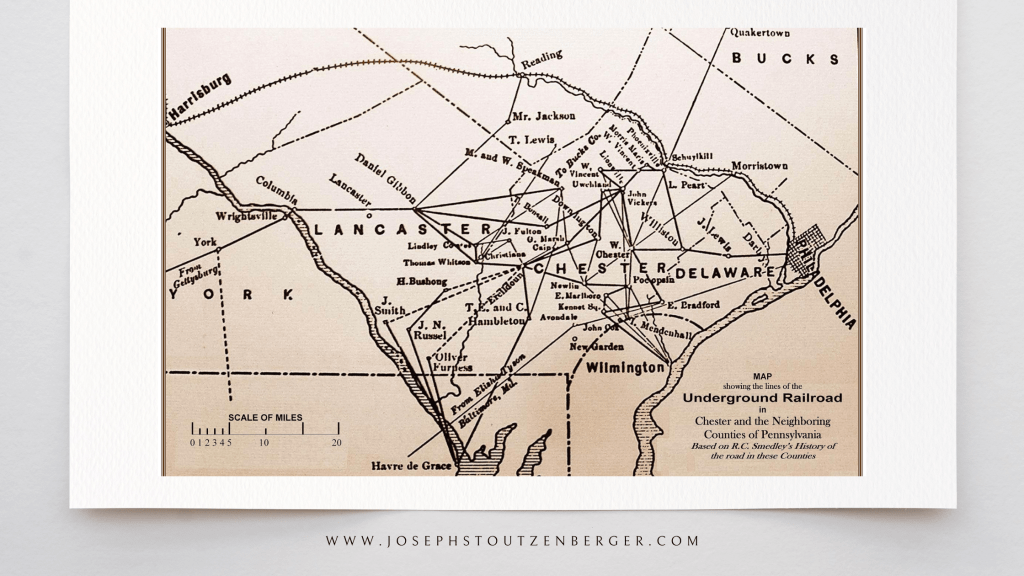
In the 1830s, a man who worked common jobs named William Otter kept a journal about his travels through the mid-Atlantic states. He spent some time in my hometown, Columbia, PA, on the banks of the Susquehanna, founded by a Quaker family to ferry people across the river. Columbia is not too far from the Maryland border. The Quaker Wright family harbored runaway slaves, and their home served as a stop on the Underground Railroad. A Maryland plantation owner, quite possibly a Catholic, as were so many plantation owners in Maryland, asked Otter to search for a slave who had run away. Otter joined with a Columbia sheriff, John Stoutzenberger, to kidnap the slave who was working for Wright at the time. Stoutzenberger devised a plot to get the runaway down to the river, where he and Otter apprehended him and had him returned to the Maryland plantation owner.
This map shows the lines of connections in southeastern Pennsylvania, including safe houses, station masters, and UGRR conductors. Wilbert Seibert included this map, which is based on Robert Smedley’s 1883 book, in his 1898 The Underground Railroad from Slavery to Freedom
No doubt, that sheriff was an ancestor of mine; I believe all Stoutzenbergers in Columbia are related. I had hoped that I had relatives who were abolitionists, but this one followed the law of the time and apprehended fugitive slaves. In his travelogue, Otter mentions that Columbia needed no description as it had gained notoriety because it was the site of one of the worst attacks by whites against blacks in the antebellum north.
Such is the history of my hometown and my family in regard to race relations and racial attitudes. Columbia was a stop on the underground railroad. For a time, it was home to Stephen Smith, the richest black man in America prior to the Civil War. It was also a place of deep animosity among some white people against black people. In my youth, Columbia was still very segregated. The town was mostly white, but there were two stretches of poorer neighborhoods where black people lived. We played on the same little league teams, and as far as I can tell, relations were cordial. I have no idea if any black families attempted to move even a block away into a white neighborhood and if that would have sparked backlash from white people again. As late as 1968, the local KKK held a cross-burning in the playground across from my home to warn Columbia black people to stay in their place.
I attended an all-white Catholic grade school. A few months into seventh grade, Sister Gertrude told us that a new student was joining our class and that we were to welcome him and treat him with respect. The new student was a black boy named Willie. Toward the end of that year, a classmate handed out invitations to his birthday party at his house. I was looking at it over lunch with other students. Willie asked me what it was. I told him it was an invitation to Scott’s birthday party and that everyone in the class was invited. Willie said he didn’t get one. I said, “Oh, everyone is invited.” That Saturday at the party, everyone seemed to be there. I sat by the door when Willie showed up, dressed in a vest and a bowtie and holding a present. Scott’s grandmother opened the door and asked Willie what he wanted. He said he was here for the party. The grandmother turned to the mother and asked her, “Did you invite this colored boy?” The mother said, No. The grandmother turned to Willie and said, “I’m sorry. You weren’t invited. We are having dancing, and there are no colored girls for you to dance with.” My heart sank as she closed the door to Willie. I felt so guilty. Of course, blacks and whites can’t dance together; how stupid of me not to realize that. Why was I so foolish as to put Willie in this horrible, humiliating position. It was all my fault.
I tell those stories because they illustrate what Jim Wallis calls America’s “Original Sin.” By no means is deep-seated racism ancient history, and certainly, American Catholicism has been right in the thick of it. As many observers have noted, Sunday is the most segregated day of the week. Most Catholic churches in the Archdiocese of Philadelphia are made up almost entirely of white people. Some city parishes remain vibrant because of an influx of immigrants—Hispanics, Vietnamese, and Africans, and some have a smattering of black parishioners. A rare few are predominantly black. Most Catholic schools at all levels remain predominantly white. Independent Catholic grade schools now offer free or low-tuition education for poor, predominantly black students, and some city schools have become more integrated. There are some black clergy and even bishops in the U.S. Interestingly, six African Americans are in the process of being named Catholic saints. On a personal level, I now have a number of mixed-race, black and white, members of my extended family, and, unlike when I was a child, I presume they dance together on occasion. But is the Catholic Church today noted for an anti-racist agenda?
When I moved from my small town to Philadelphia with its strong Catholic population, my impression was that Catholics placed an emphasis on “being nice.” They tend to be kind and cordial. A question is, given the lingering effects of racism in the country, is that enough? Given the depth and scope of the problem, combatting racism entails being more than nice. It requires making a priority to address the racial divide in the church and the country and dedicating resources to counteracting all forms of racism. That man, who was kidnapped in my hometown and sent back to slavery, and my classmate Willie deserve nothing less.
Some friends and I were talking about the crises we are facing today. Someone said, “Every generation has its crises to deal with.” I thought about that. As horrible as they were, no one thought that World Wars I and II would bring about the end of life on earth. Earlier pandemics were devastating, but they didn’t signal the end of all human life. During the Cold War between the US and the Soviet Union, especially in the 1950s and 1960s, people lived with the specter of nuclear catastrophe ending human life. There were even novels written, and movies made about what that would be like. At the risk of sounding dreary, the environmental crisis we face today seems different. I am writing this in what scientists tell us is the earth’s hottest month in history, July 2023. In some places, touching the ground can result in severe burns. For a stretch where I lived, going outside for a period of time was like smoking seven packs of cigarettes a day. Oceans are becoming so hot that important aquatic species are dying off. Bees necessary for pollination are becoming more and more scarce, choking to death on pesticides. Droughts and severe storms are making some places almost uninhabitable. Some farmers in Kansas this year have given up on their crops and are plowing them under due to the extreme heat and lack of rainfall. That can’t be good for the world’s food shortage.
I look upon the smiling, trusting face of my almost-two-year-old youngest grandson and want a verdant, healthy planet he can explore and enjoy for years to come. Is there any hope that the earth will continue to be the beautiful blue marble of a planet, unique in its ecosystems and capable of sustaining life? A key to the answer to that question is the word “hope” itself. Hope is not the same as a wish. The Lord’s Prayer is filled with hope: “Thy kingdom come, on earth as it is in heaven.” All indications are that Jesus understood that line to be a call to action. The Lord’s Prayer is implicitly contrasting the way things are with the way things ought to be. It’s not passive wishful thinking but a daily reminder to commit to creating the world as God intended it to be. “I wish that the earth would stop heating up out of our control” is not hope unless it stirs one to action. “I realize that what’s happening now is hazardous, and I commit to doing something about it” is a statement of hope. Praying for God’s help and guidance does not eliminate personal responsibility. For instance, looking into whether installing solar panels on my roof would make a difference is an act of hope. Given the conditions today, advocating for a reduction in the use of fossil fuels is a statement of hope. Supporting more environmentally-friendly means of transportation is hopeful. Praying “thy kingdom come” is not a wish but a hope-filled reflection of what can be and exploring ways to make it happen.
Right from the start, Pope Francis made concern for the environment a major focus of his papacy. In his first official homily as pope, he reminded us that we are caretakers responsible for the wellbeing of the earth. Government spending, business decisions, and personal behaviors need to make environmental impact a key concern in what we do. An underlying obstacle is the attitude that we are powerless to do anything about these environmental catastrophes. That’s the opposite of a hopeful attitude. What can we do to prevent month-long heatwaves and the continuing threat of tornadoes, droughts, heat-related wildfires, and flooding? While there are no simple solutions, that doesn’t mean that there are no solutions. A change of attitude is an essential starting point: we can make a difference.
Our children will have their work cut out for them. What about us today? Can we bequeath to them a legacy of hope manifest in an array of concrete measures to confront the problems we are facing right now? Let’s hope so.
In the 1970s, I taught religion in a Catholic suburban high school. An older man, part of the janitorial staff, cleaned the bathrooms and emptied the overflowing trash cans in the cafeteria after lunch. Generally, he was one of those invisible people, like wallpaper or one of the fixtures he cleaned, that are simply taken for granted. I decided to speak with him one day. I discovered that he was an elder in his inner-city, all-black store-front church in Philadelphia. I asked him if he would come in and speak to my class one day. He said he would be glad to. On the appointed day, he arrived wearing a rumpled suit and carrying a well-worn bible. After I introduced him, he asked the students, “How many of you accept Jesus as your personal Lord and Savior?” No hands went up. He asked again, “Come on now. You go to a Christian school. How many of you accept Jesus in your heart?” One hand hesitantly went up. The speaker then went on to talk about how important Jesus was in his life, frequently opening his bible and reading a passage from it. He was mesmerizing and captivating. After class, he went to a locker room, changed into his janitorial clothes, and went about his business of sweeping floors and cleaning windows.
You can draw out any number of themes in that story. It seems to be an embodiment of racism and classism. Practically all the students were white; the old janitor was black. Most of the students lived in upper-middle-class neighborhoods, while the guest speaker commuted from a poor city neighborhood. It also serves as a reminder of our inter-connectedness. Trash cans do not empty themselves. Real people with real lives do that. It’s important to realize how systems operate. Cleaning bathrooms is as essential as overseeing the use of computers or grading papers. A school is a miniature neighborhood, and everyone there should be treated neighborly. The incident is also a reminder to look for signs of the holy in people and places often overlooked.
Gandhi spent a portion of his days spinning cloth. He never wanted to be too far removed from the simple labor that most Indians engaged in. He wanted all the people of India to do the same lest they lose touch with the reality of the simple life of most of the people in his country. Since 2012 the Catholic bishop of Yakima, Washington, has required his seminarians, men preparing for priesthood, to spend their summers working in the fields and orchards alongside migrant workers. He wants them to know firsthand how many of the people they will be called to serve live and work. Much like my speaker with my students, migrant farmhands can be overlooked but prove to have much to teach the seminarians. Privilege and clericalism dissolve when trying to learn the art of picking cherries at an acceptable pace from an experienced picker. Fresh fruit on the kitchen table doesn’t just appear there, and the bishop reminds his seminarians that the bread and wine they consecrate at Mass come from the hands of migrant workers.
A Sufi story tells of a renowned holy man invited to a banquet. He decides to arrive dressed as a poor beggar, and the host places him at the base of the table. The holy man returns in his fancy garb, and the host invites him to sit at the head of the table. The holy man strips off his clothes, places them on the chair, and says, “You obviously want to honor my clothes and not me, so I leave them here for you.” The host saw only appearances. Looking a little more closely would have revealed the true worth of the guest.
Jesus tells a similar story of a man hosting a banquet to which the well-to-do don’t show up, so the host beckons his servants to go to the streets and bring in those who are downtrodden to enjoy the feast. All through the gospels, Jesus sees beauty and worth in people others would rather dismiss—even dreaded lepers, despised tax collectors, and women plying their trade as prostitutes.
Yogi Berra famously said, “You can see a lot by just looking.” Perhaps the message of these stories is the importance of developing the art of seeing. Sometimes we look but don’t see. Seeing requires breaking through pre-conceived perceptions and being open to new viewpoints. Life is happening all around us, and it is always richer than we might expect. If we develop the art, we can see a lot by just looking.
Originally Published, November 20, 2022. Today’s American Catholic(TAC) is a journal of inquiry, reflection, and opinion on matters of ecclesial, civic, and spiritual life.
A Wonderful Review for:
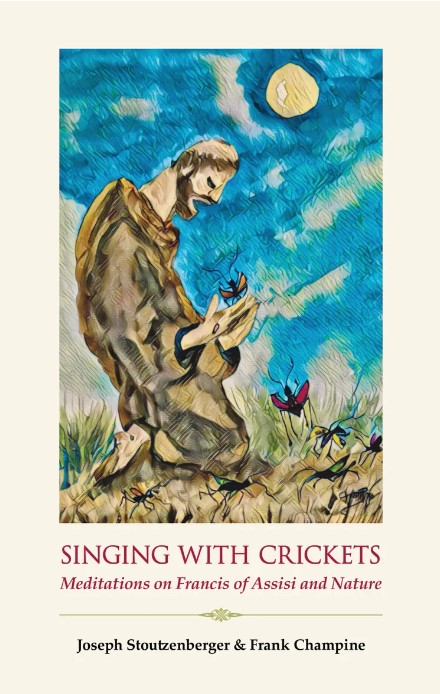
Singing with Crickets: Meditations on Francis of Assisi and Nature By Joseph Stoutzenberger and Frank Champine Tau Publishing, 2022 $17.95 98 pp.
It is rather interesting that the longest chapter in this slender volume is the introduction, where the author outlines his premise that Saint Francis of Assisi remains an example to the global community in the 21st century, especially when it comes to the Catholic Church’s very recent shift toward care for creation.
Author Joseph Stoutzenberger cites the ways that recent popes have connected environmental concerns not just with the gospels, but with the “seamless garment” of life. “Ecology, for whom Francis serves as a worthy patron saint, means ‘the study of our home,’” he writes. “We have no other place to live than the lovely and intricately designed earth that is our home.”
More than just a “scientific dilemma calling for scientific solutions,” the author points out that caring for our common home is a mandate hearkening back to Jesus himself, mirrored to perfection by Saint Francis.
Three sections follow the introduction: “The Words of Francis,” “Tales of Francis and His Friends,” and “The Canticle of the Creatures.” These short reflections—or “meditations,” as Stoutzenberger terms them—are not meant to be devoured but read prayerfully one at a time and contemplated quietly. Each includes a narrative, a prayer with scriptural quotes, and a poem and visual rendering by artist Frank Champine on themes such as “The Universe Groaning,” “Gentle as a Lamb,” and even “Sister Death.”
In addition to authoring two other Francis-inspired books, Stoutzenberger is a professor emeritus of religious studies at Holy Family University in Philadelphia, Pennsylvania. He is also described as a former social worker, high school religion teacher, and college campus minister.
Though clearly an academic who has studied the writings of and about Saint Francis extensively, Stoutzenberger takes the example of the saint and keeps his phrasing simple and to the point. He doesn’t embellish the stories of Francis, instead creating insightful scenarios with which readers can identify and consider in the face of current ecological crises.
Champine is retired, with experience as an educational consultant, college instructor, and social studies teacher. His artwork has appeared in other books, as well as his own published work of poetry and paintings. The image of Saint Francis on the cover and another at the end of the introduction fall in a modern vein, while others range from more traditional in style—a stalk of bamboo, for instance, a group of flowers, a sunset—to the rather abstract.
The final section of the book contains a brief list of organizations focused on various aspects of the environment. Notably absent, especially since this book is recently published, is the Laudato Si’ Movement, which is at the forefront of implementing Pope Francis’s climate concerns as outlined in his encyclical of the same name.
There is one odd feature in the printing of this book: while the preliminary pages in most volumes use Roman numerals to differentiate that section from the main body of the text, the first 10 pages here have periodic numbering, which then starts over with the introduction on page 1.
Given the number of pages, the book’s price may seem rather high, but for those seeking to deepen their understanding of Saint Francis and the ongoing need to work for climate justice, it will be a good investment. ♦
Julie A. Ferraro has been a journalist for over 30 years, covering diverse beats for secular newspapers as well as writing for many Catholic publications. A mother and grandmother, she currently lives in Atchison, Kansas. Her column, “God ‘n Life,” appears regularly in Today’s American Catholic.
I have been hearing a great deal about free speech these days. It is a bedrock of American democracy, enshrined in the First Amendment to the Constitution. However, if by free, we mean without consequences, then there is no such thing as free speech.
I knew a fellow teacher who used to make deeply disparaging remarks about co-workers. When the target of his attacks called him on it, he would simply say, “I was only joking,” as if that excused his hateful speech. Can you imagine saying, “Why are you wearing that ugly dress? Did you get it from your grandmother’s closet?” and then dismissing the comment as a joke? The harm is done, and the speaker knows it. I have been hearing politicians making hateful, hurtful, belittling remarks about anyone who disagrees with them. That’s not free speech. That’s a sinful use of language, a violation of the eighth commandment not to bear false witness.
Jesus was attuned to the reality that our words can be as deadly as physically harming another. Here is just one instance when he called out those who would speak ill of another: “You have heard that it was said to those of ancient times, ‘You shall not murder’; and ‘whoever murders shall be liable to judgment.’ But I say to you that if you are angry with a brother or sister, you will be liable to judgment; and if you insult a brother or sister, you will be liable to the council; and if you say, ‘You fool’, you will be liable to the hell of fire” (Matthew 5:21-22). Pretty strong words, but pretty insightful. Hate speech is fuel for creating hell on earth. Later Jesus says, “it is not what goes into the mouth that defiles a person, but it is what comes out of the mouth that defiles” (Matthew 15:11). Some popular politicians exhibit a sewer-mouth and foment an atmosphere of anger and hatred. All in the name of free speech!
Whatever happened to the simple wisdom we learned as children? “If you can’t say something good about someone, don’t say anything.” The French priest who began the Sisters of St. Joseph proposed the following maxim for those who wished to live a Christian life: “Always speak favorably of others and value highly the good in them, excusing and covering up, in the best way you can, the deficiencies they might have.” That’s a far cry from yelling out real or imagined flaws in others.
I have a friend who bears within himself the painful memory of coming home in third grade with C’s on his report card. His strict, insensitive father told him, “Look at those grades! You are stupid and will never amount to anything!” That friend went on to achieve quite a few accomplishments, using his mind. However, whenever he failed at something, he slumped into depression and said, “My father was right. I am stupid. Why do I even try to presume otherwise.” Words can be deadly. A hurtful, inconsiderate remark is like a pebble in a pond, spreading an atmosphere of hate throughout society that can linger a very long time. Hindus call it bad karma, whose effects last over many lifetimes. Perhaps, more importantly than free speech, the bedrock of civil society is kindness, first and foremost, kind words. I have often been struck by the image of Jesus healing a man who, from birth, could not speak. I wondered what the first words would be if someone had never spoken before and had time to think about what they wanted to say after a lifetime of silence. Would it be the nasty words spoken by my fellow teacher, who was always quick to point out another’s weaknesses? Would it be to enter into the discourse I hear on cable news channels or from commentators and politicians who can’t bring themselves to say a kind word about anyone they dislike? I would hope that when given the gift of speech by Jesus, the man born unable to speak would find it in himself to utter words of gratitude to God and comfort and compassion to those around him. All of us able to speak would do well to appreciate that speech is a gift, even if bestowed upon us at an early age. What a shame it is, and how deadly, when we don’t use it to offer comfort, compassion, and understanding of others.















 Joseph Stoutzenberger